
Why UTV Suspension Setup Can Transform Your Ride
UTV suspension setup is the process of adjusting your vehicle’s shocks, springs, and damping to match your weight, riding style, and terrain. When done right, it transforms a jarring, uncomfortable ride into a smooth, controlled adventure.
Quick Answer: The Essential Steps for UTV Suspension Setup
- Set Ride Height First – Adjust spring preload to achieve 25-30% sag with your typical load
- Tune Compression Damping – Control how fast your shocks compress over bumps
- Adjust Rebound Damping – Control how quickly your shocks extend after compression
- Test and Refine – Make one change at a time and test on your typical terrain
Ever been out on the trail, bouncing around like you’re in a rock tumbler, thinking “Is this really as smooth as it gets?” You’re not alone. Most UTVs leave the factory with suspension set for an average rider on average terrain—which means it’s not ideal for your specific weight, your cargo, or your favorite trails in Northern Nevada.
Here’s the reality: stock UTV suspension rarely works perfectly from the factory. OEM RZR springs can sag within just 300-400 miles. Add a few passengers (easily 750+ pounds), aftermarket accessories, and a full tank of fuel, and your ride height drops significantly. Your suspension isn’t doing its job anymore.
But proper suspension setup isn’t just about comfort. It’s about control, safety, and getting the most out of your machine. Whether you’re crawling rocks in the Virginia Range, blasting across the Black Rock Desert, or navigating tight mountain trails around Lake Tahoe, your suspension needs to be dialed in.
The good news? You don’t need to be a suspension guru to make meaningful improvements. Understanding a few core concepts—ride height, preload, compression, and rebound—will get you 90% of the way there.
The Anatomy of Your UTV’s Suspension
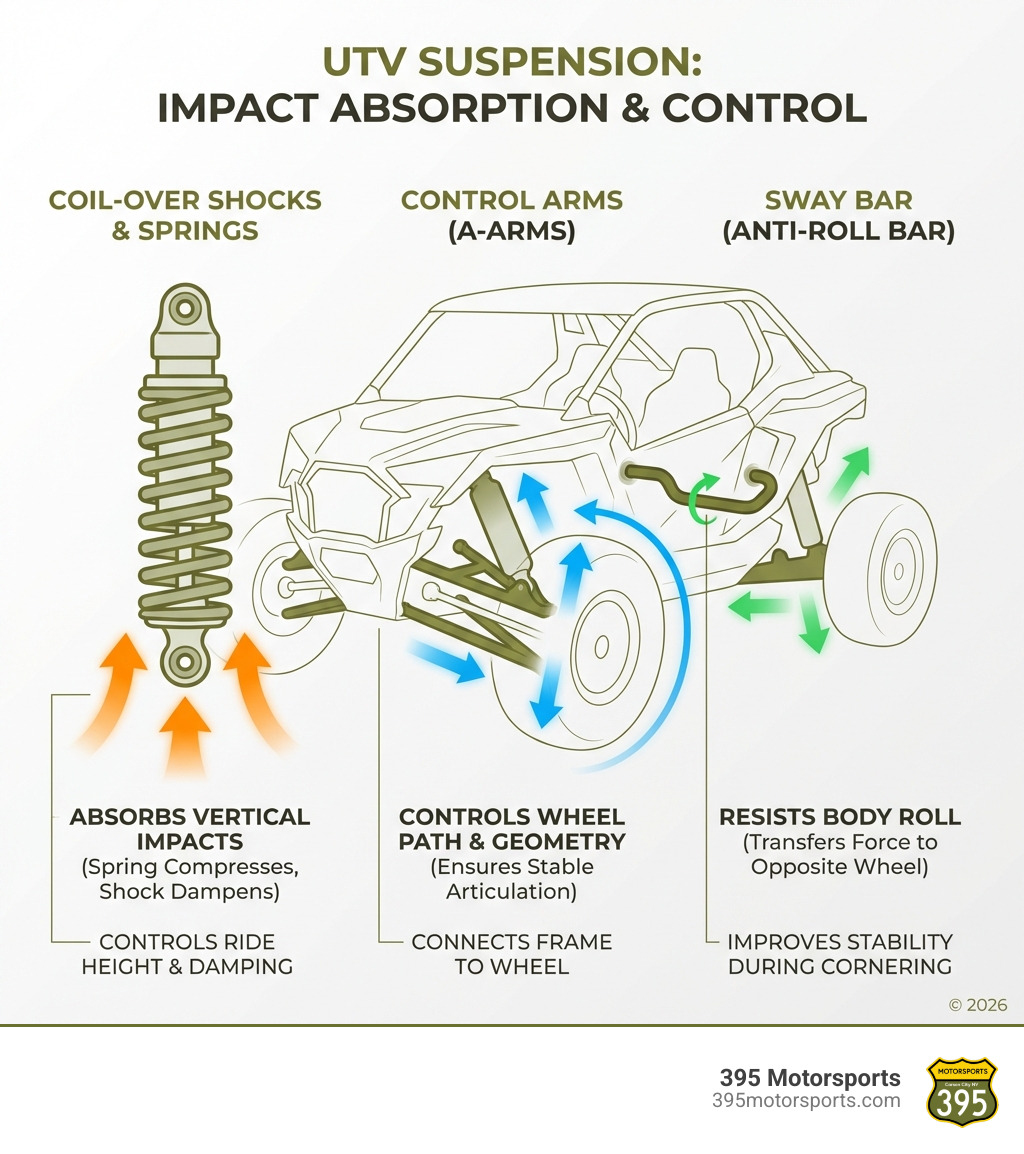
Before making adjustments, it’s key to understand what each part of your UTV’s suspension does.

- Shocks & Dampers: Often called shock absorbers, these are the workhorses that absorb and dissipate energy from impacts. Damping refers to the shock’s ability to control the speed of suspension movement through internal valving. Without proper damping, your UTV would bounce uncontrollably. Most UTVs use coil-over shocks, where a spring wraps around the shock.
- Springs: These support the entire weight of your UTV, plus passengers and cargo. The right spring rate (stiffness) is essential to prevent bottoming out while absorbing impacts. Many performance UTVs use dual-rate springs (a soft tender spring for small bumps and a stiff main spring for big hits).
- Control Arms (A-Arms): These robust arms connect your wheels to the chassis, allowing for independent movement and maintaining proper wheel alignment. This is crucial for traction and handling on the uneven terrain found near Lake Tahoe and the Virginia Range.
- Sway Bars: Also known as anti-roll bars, these connect the left and right sides of the suspension to reduce body roll during cornering, keeping the UTV stable at speed. The trade-off is that they can limit wheel articulation in slow, technical rock crawling sections.
Together, these components work to keep your tires on the ground, maximize traction, and provide a controlled, comfortable ride.
The Foundation: Setting Your Ride Height and Preload
The most fundamental part of any UTV suspension setup is correctly setting your ride height. It’s the foundation for all other adjustments. Get this wrong, and no amount of fine-tuning will fix your ride.
- Ride Height & Preload: Ride height is your ground clearance, measured from the frame to the ground. It’s adjusted using spring preload—the initial tension on your springs. More preload raises the UTV; less preload lowers it.
- Sag: This is how much the suspension compresses under your typical load (riders, fuel, gear). Too much sag reduces upward travel for bumps; too little makes the ride harsh. The goal is 25-30% of total suspension travel (e.g., 4.5 to 5.5 inches of sag for a UTV with 18 inches of travel).
Added weight from passengers (up to 750+ lbs), accessories, and cargo dramatically affects sag. You must tune for your typical loaded weight. Also, be aware of spring fatigue. Stock springs lose effectiveness over time; for example, OEM RZR springs can sag in just 300-400 miles. This compromises your ride height and performance.
For more detailed guides, check out our resources at 395 Motorsports UTV Suspension Setup Tips & Videos.
How to Measure and Adjust Ride Height
- Prepare: Park on a level surface with tires at operating pressure. Load the UTV with your typical passengers, gear, and a full fuel tank for an accurate measurement.
- Settle and Measure: Roll the UTV back and forth a few feet to settle the suspension. Measure the distance from the ground to the frame rails at the front and rear.
- Adjust Preload: Use a spanner wrench on the shock’s threaded collars to adjust preload. Tighten the collar to increase ride height (reduce sag) or loosen it to decrease ride height (increase sag). Make equal adjustments to both shocks on an axle (left and right).
- Re-measure and Refine: After adjusting, roll the UTV again to settle it, then re-measure. Repeat until you hit your target sag (25-30%). Keep notes of your settings.
Fine-Tuning for Peak Performance: Damping Explained
Once your ride height and preload are dialed in, it’s time to fine-tune your UTV’s damping. This is where you really start to customize your ride’s feel. Damping refers to the shock absorber’s ability to control the speed at which your suspension compresses and extends. It’s what prevents your UTV from feeling like a pogo stick.

- Damping: In simple terms, damping dictates how quickly your shocks move. Without proper damping, your springs would bounce freely, leading to a chaotic and uncontrolled ride. Damping allows the springs to do their job (support weight and absorb energy) while keeping the movement smooth and controlled.
- Compression: This refers to the upward movement of your wheel towards the chassis when it encounters an obstacle (like a bump, rock, or jump landing). Compression damping controls how quickly and easily the shock compresses.
- Rebound: This is the downward movement of your wheel away from the chassis after it has compressed. Rebound damping controls how quickly the shock extends back to its original position.
Mastering Compression: From Small Bumps to Big Hits
Most modern UTV shocks, especially on performance models, offer adjustable compression damping. You’ll often find two types:
- Low-Speed Compression (LSC): This affects how your UTV reacts to slower, more gradual suspension movements. Think body roll during turns, gentle whoops, g-outs (when the suspension compresses slowly but deeply), or braking bumps.
- Increasing LSC: Makes the UTV feel more stable in corners, reduces body roll, and helps prevent bottoming out over gradual dips. However, too much LSC can make the ride feel harsh over small, choppy terrain.
- Decreasing LSC: Provides a softer, more plush ride over small bumps and chatter, improving comfort. But too little can lead to excessive body roll and a “wallowy” feeling.
- High-Speed Compression (HSC): This controls how your UTV handles rapid, forceful impacts, such as hitting sharp-edged rocks, landing from a jump, or blasting through large whoops.
- Increasing HSC: Crucial for preventing bottoming out on big hits and hard landings. It provides a firm platform for aggressive driving. Too much, however, can make the UTV feel harsh and deflect off obstacles.
- Decreasing HSC: Allows the suspension to absorb large impacts more freely, which can be comfortable if you’re not pushing the limits. But too little HSC means you’ll be bottoming out frequently.
Adjustments are typically made via a knob or screw on the shock body or reservoir. Start with your manufacturer’s recommended settings or a middle-ground, and make small, incremental changes (one or two clicks at a time) as you test.
Controlling Rebound: Eliminating Bucking and Packing
Rebound damping is often overlooked but is incredibly important for controlling your UTV’s behavior after hitting an obstacle. Incorrect rebound settings can lead to two common and undesirable phenomena:
- “Packing Up”: This happens when your rebound damping is too slow. The shock doesn’t extend quickly enough after a series of bumps (like in a whoop section). The suspension progressively compresses with each subsequent bump, eventually running out of travel. This leads to a harsh ride, loss of control, and can feel like your UTV is “swapping” or becoming unstable.
- “Bucking” or “Kicking”: This occurs when your rebound damping is too fast. After compressing over a bump or jump, the shock extends too quickly, launching the UTV upwards. This can be unsettling, dangerous, and makes it hard to keep your tires firmly planted on the ground.
The goal of rebound adjustment is to allow the shock to extend quickly enough to be ready for the next bump, but slowly enough to maintain control and keep the tires in contact with the ground. You’ll typically find the rebound adjuster (a screw or knob) at the bottom of the shock shaft.
- Increasing Rebound (slowing it down): Helps prevent bucking and keeps the tires on the ground after impacts, improving traction and stability.
- Decreasing Rebound (speeding it up): Needed if your suspension is packing up, allowing it to extend faster and recover for successive bumps.
Again, start with small adjustments and test thoroughly. A good rule of thumb is to have the front rebound slightly quicker than the rear for better chassis balance, especially in faster terrains.
The Ultimate UTV Suspension Setup for Any Terrain
There’s no such thing as a “one-size-fits-all” UTV suspension setup. The ideal settings for tackling the sand dunes of the Black Rock Desert will be vastly different from what you need for rock crawling in the Virginia Range or high-speed runs on hard-packed trails around Carson City. The importance of testing cannot be overstated. Make one change at a time, test it, and then evaluate the results.
We’ve put together some comprehensive resources to help you dial in your UTV for specific terrains. Check out our detailed guides at 395 Motorsports Suspension Tuning for Terrain.
Sand Dunes
When you’re playing in the sand, whether it’s the vast expanse of the Black Rock Desert or smaller dunes, your goal is often to “float” over the surface rather than digging in.
- Setup: Generally, a softer suspension is preferred.
- Decreased Compression Damping: This allows the suspension to absorb the rolling nature of dunes and smaller chatter more easily, providing a smoother ride and better flotation. You might still want some higher-speed compression for big jumps or transitions.
- Lower Tire Pressure: Crucial for sand. Lowering your tire pressure increases the tire’s contact patch, allowing your UTV to float on the sand rather than digging in. This also contributes to a softer overall feel.
- Rebound: Fairly slow rebound can prevent the UTV from “unweighting” over dune crests, which helps maintain stability.
Rocky Trails & Rock Crawling
For the technical challenges of rocky trails and serious rock crawling, found in abundance in the Sierra Nevadas, articulation and controlled movement are paramount.
- Goal: Maximize wheel articulation to keep all four tires on the ground, absorbing impacts without harshness, and maintaining predictability.
- Setup: Very soft compression damping is often desired for maximum flex, allowing wheels to conform to uneven terrain.
- Slower Rebound: This is key for predictability. On steep ascents or descents, a slow rebound prevents the UTV from “kicking” or unloading too quickly, which could lead to a loss of traction or even a rollover.
- Sway Bar Removal Trade-offs: For dedicated rock crawling, many riders consider temporarily removing their sway bars. This significantly increases independent wheel travel and articulation, allowing the UTV to “flex” over obstacles. However, be aware that removing the sway bar will drastically increase body roll at higher speeds, so it’s a modification best suited for slow, technical terrain. If you do remove it, you may need to increase spring preload slightly to compensate for the lost roll stiffness.
Hard-Pack Dirt & High-Speed Trails
When you’re looking for speed, stability, and precise handling on hard-packed dirt roads or faster trails, your UTV suspension setup needs to be firmer.
- Goal: Maintain stability, minimize body roll, and provide responsive handling.
- Setup: Generally, a stiffer suspension is preferred.
- Increased Spring Preload & Damping Rates: A bit more preload will raise your ride height slightly and give the springs a firmer feel. Increase both low-speed and high-speed compression damping to reduce body roll in corners and prevent bottoming out over unexpected dips or whoops at speed.
- Faster Rebound: You want the shocks to extend quickly enough to recover for successive bumps without packing up, but not so fast that the UTV becomes unstable or “kicks.” This helps keep the tires glued to the ground, especially through choppy sections.
- Sway Bars: Keep your sway bars engaged for improved stability and reduced body roll during high-speed cornering.
Common Mistakes and When to Upgrade
Even with a good understanding of the components and adjustments, it’s easy to fall into common traps when tuning your UTV suspension setup. We’ve seen it all, and we’re here to help you avoid the pitfalls and know when it’s time for a professional upgrade.
Top Tuning Mistakes to Avoid for Your UTV Suspension Setup
- No Baseline Measurement: One of the biggest mistakes is adjusting without knowing where you started. Always measure your ride height and record your current clicker settings before making any changes. This allows you to revert if things go wrong and understand the impact of each adjustment.
- Changing Too Much at Once: Resist the urge to tweak every knob and dial simultaneously. When experimenting with setups, change one variable at a time (e.g., only front rebound, or only rear low-speed compression). This way, you can clearly identify the effect of each change.
- Over-Preloading for Lift: Many riders add excessive preload to achieve more ground clearance. While it does raise the UTV, too much preload reduces your suspension’s effective droop (downward travel). This makes the ride harsher, reduces traction, and can actually make your UTV more prone to rolling over.
- Confusing Stiffness with Damping: Preload and spring rate primarily affect stiffness. Damping controls how quickly the suspension moves. A soft spring with high damping can feel firm, and a stiff spring with low damping can feel bouncy. Understand the difference.
- Ignoring Tire Pressure: Your tires are an integral part of your suspension system. Incorrect tire pressure can mimic suspension issues. Always set your tire pressure for the terrain you’re on before making suspension adjustments.
- Not Testing After Adjustments: Don’t just make changes in the garage. Take your UTV out on the terrain you’re trying to optimize for and feel the difference. Learn from adjustments that don’t work as expected.
Record-keeping is incredibly important. Keep a small notebook in your UTV or use a notes app on your phone to log every change you make, along with the date, terrain, and your subjective assessment of the ride. This data is invaluable for future adjustments.
Signs You Need a Suspension Upgrade
While fine-tuning your stock suspension can yield significant improvements, there comes a point when the factory components just can’t keep up with your demands.
- Worn Springs & Excessive Sag: If your UTV is consistently sagging even after maximizing preload, or if you notice your ride height is significantly lower than it used to be, your springs are likely worn out. OEM RZR springs can sag within 300–400 miles, and Kawasaki KRX 1000 springs start to settle at around 700 miles. Worn springs compromise everything.
- Coil-Bind: If your springs are fully compressing (coil-binding) before your shocks reach full compression, you’re running out of effective spring travel. This is a clear sign you need stiffer springs or a dual-rate spring upgrade.
- Consistently Heavy Loads: If you frequently carry a full load of passengers (which can add 750+ pounds) or heavy cargo, stock springs are simply not designed for that sustained weight. Upgrading to heavier-duty springs or a dual-rate spring kit is often the best solution.
- Running Out of Adjustment Range: If you’ve maxed out your compression or rebound adjusters (either fully soft or fully stiff) and still aren’t achieving the desired ride quality, your shocks’ internal valving or spring rates are likely inadequate for your needs.
- Desire for Performance: For aggressive riders, racers, or those who simply demand the absolute best ride quality, aftermarket shocks and springs offer a level of tunability and performance that stock components can’t match.
When you’re ready to take your UTV suspension setup to the next level, our team at 395 Motorsports in Carson City, NV, can guide you through the options, from spring upgrades to complete aftermarket shock systems. We’re here to help you get the most out of your UTV. Explore professional suspension services and upgrades.
Frequently Asked Questions about UTV Suspension
We get a lot of questions about UTV suspension. Here are some of the most common ones we hear from riders in Northern Nevada and Northern California:
How much sag should my UTV have?
A good starting point for most UTVs is 25-30% of the total suspension travel. For a UTV with 18 inches of travel, this would be around 4.5 to 5.5 inches of sag when loaded with your typical gear and passengers. This ensures you have enough upward travel to absorb bumps and enough downward travel to maintain tire contact over dips, optimizing both comfort and control.
What’s the first thing I should adjust on my UTV suspension?
Always start with ride height. Setting your spring preload to achieve the correct ride height and sag for your specific weight is the foundation. All other adjustments, like compression and rebound, depend on the ride height being set correctly first. If your ride height is off, your damping adjustments won’t be as effective, and your UTV’s geometry will be compromised.
My UTV feels like it’s “bucking” over bumps. What’s wrong?
A “bucking” or “kicking” sensation is a classic sign that your rebound damping is set too fast. The shock is extending too quickly after a bump, launching the rear of the vehicle upwards. To fix this, you need to slow down your rebound. Turn the adjuster “in” (typically clockwise, or towards a “+” sign if labeled) a few clicks at a time until the feeling subsides and the UTV feels more controlled over bumps.
Your Adventure, Perfectly Tuned
Mastering your UTV suspension setup is a journey, not a destination. It’s about understanding the fundamentals—ride height as your foundation, and damping as your fine-tuning—and then patiently refining those settings to match your unique riding style and the diverse terrains we’re lucky to have here in Northern Nevada.
A well-tuned suspension isn’t just about comfort; it’s about control, safety, and open uping your UTV’s full potential. Whether you’re a weekend warrior tackling local trails or an avid explorer venturing deep into the backcountry, getting your suspension dialed in will dramatically improve your experience.
At 395 Motorsports, we’re more than just a dealership; we’re your local Northern Nevada experts for parts, service, and advice. We understand the unique demands of our local riding areas and are passionate about helping you get the most out of your machine. Don’t settle for a “good enough” ride.
Get your UTV dialed in with our expert suspension services today, and transform every outing into a perfectly tuned adventure.